2026 Labor Day DWI Crackdown and “No Refusal”: What Houston and Galveston Drivers Should Know
By Tad Nelson: Board-Certified Criminal Defense Lawyer & Lawyer Scientist
Galveston drivers should expect the 2026 Labor Day DWI crackdown to reach Galveston and Galveston County, alongside Houston, Harris County, and other nearby areas, with increased impaired-driving patrols from August 14 through September 7 and the national campaign running from August 19 through Labor Day. For drivers and residents in Galveston, Houston, and the surrounding counties, the immediate questions are how holiday DWI enforcement works, whether a local No Refusal operation will be announced, what your rights are during a stop or when police request a breath or blood test, what can happen if you refuse, and what legal steps matter after an arrest during one of Texas’s highest-risk holiday periods.
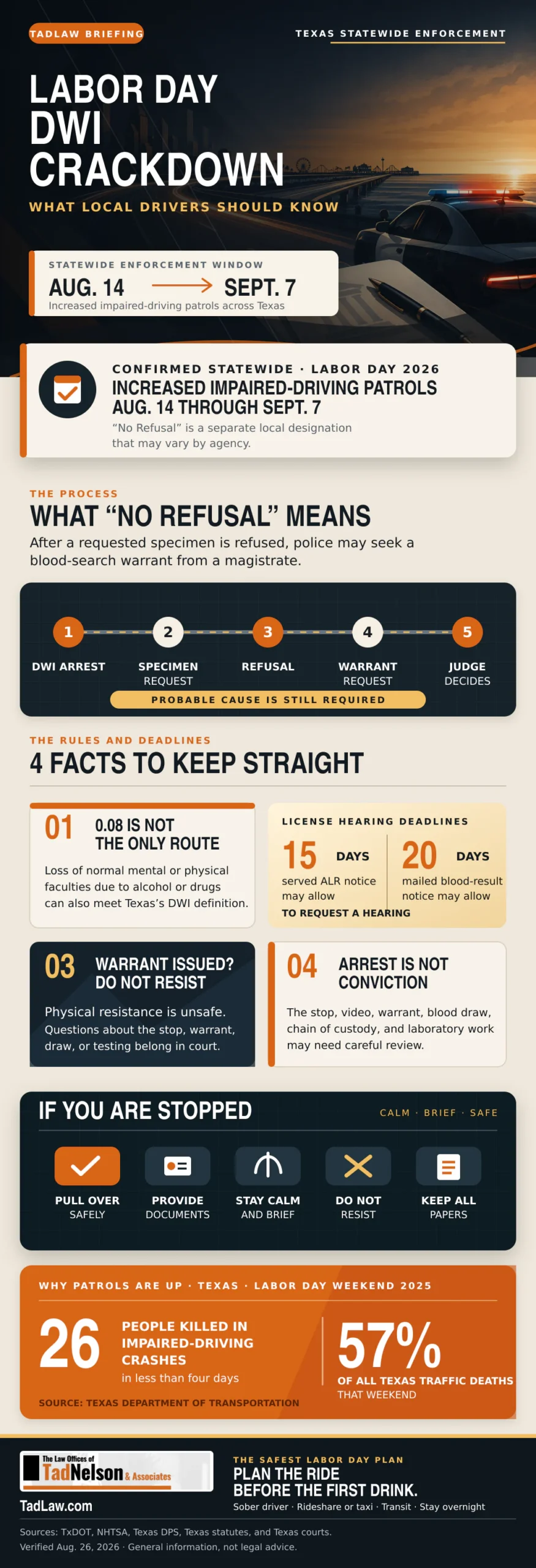
We did not locate a new official Labor Day “No Refusal” designation for Harris County or Galveston County in the public agency announcements we reviewed. However, that does not mean one will not be announced closer to the holiday. It also does not change the fact that police can seek a blood-search warrant in an ordinary DWI investigation when the legal grounds exist.
If a specific local No Refusal operation is announced, it does not erase a driver’s rights, create automatic probable cause, or make a blood result immune from challenge. It usually means the warrant process has been organized to move faster during a high-enforcement period, which is why understanding the enforcement environment, the risks of refusal, what to do during a DWI stop, and the post-arrest consequences can help you avoid severe penalties and better protect yourself legally.
What Labor Day DWI enforcement is confirmed for Houston and Galveston Island in 2026?
The Texas Department of Transportation says it is providing grant funding to agencies across Texas as they increase efforts to identify and arrest impaired drivers from August 14 through September 7. The National Highway Traffic Safety Administration announced added patrols from August 19 through Labor Day, Monday, September 7, 2026.
Confirmed details by area:
- Texas statewide. Confirmed: TxDOT-backed increased impaired-driving enforcement from August 14 through September 7. Open item: Agency staffing and patrol details can differ by city and county.
- Houston and Harris County. Confirmed: The statewide and national enforcement periods apply. Open item: No new 2026 Labor Day No Refusal designation was located in the public notices reviewed.
- Galveston and Galveston County. Confirmed: The statewide and national enforcement periods apply. Open item: No new 2026 Labor Day No Refusal designation was located in the public notices reviewed.
Why are Texas officers increasing Labor Day DWI patrols and security management?
TxDOT reports that drug- or alcohol-related crashes accounted for 35% of all Texas crash fatalities in 2025. During Labor Day weekend 2025, that share rose to 57%. Twenty-six people were killed in impaired-driving crashes in less than four days, which TxDOT described as one death every three hours.
Those figures cover Texas as a whole, not Houston or Galveston alone. They explain the statewide enforcement push without claiming that either local county had the same rate.
The campaign also covers more than alcohol. Cannabis, prescription drugs, cold medicine, illegal drugs, and combinations of substances may support a DWI allegation if police claim the substance caused a loss of normal mental or physical faculties.
What does “No Refusal” mean in a Texas DWI investigation?
No Refusal is an enforcement method, not a separate criminal charge. When an arrested driver declines a requested evidentiary breath or blood specimen, officers may prepare a sworn warrant application and present it to a magistrate. A No Refusal operation is built to make that process quicker.
The judge still has a job to do. A warrant is not automatic merely because the calendar says Labor Day. The application must present facts that support probable cause. The Texas Court of Criminal Appeals has explained that a valid blood-search warrant rests on facts establishing probable cause presented to a neutral and detached magistrate.
No Refusal does not mean:
- Every driver can be stopped without a lawful reason.
- Every refusal produces a valid warrant.
- A blood draw proves guilt by itself.
- Testing, storage, transport, lab work, or interpretation cannot be questioned.
Houston-area agencies used a multi-agency No Refusal initiative over Labor Day weekend in 2025. That prior operation helps explain why drivers hear the phrase each holiday, but a 2025 announcement is not proof of a 2026 designation.
Can a Texas driver refuse a breath or blood test?
Texas has an implied-consent law. After a qualifying DWI arrest, an officer may request an evidentiary breath or blood specimen and give the statutory warning about the consequences of refusal.
A driver can decline the officer’s request, but refusal can start a separate driver-license case. Police may also ask a judge for a blood-search warrant. If a valid warrant is issued, physically resisting the draw is unsafe and does not preserve a legal objection. Questions about the stop, arrest, warrant, draw, and laboratory work can be raised through the legal process.
Some DWI cases also involve statutory specimen rules or recognized warrant exceptions. Crashes, injuries, prior convictions, unconscious drivers, and other facts can change the analysis. A short holiday guide cannot resolve those case-level questions.
For a fuller explanation, see TadLaw’s guides to No Refusal weekend cases, blood-test refusal and warrants, and challenging blood and breath evidence.
Can someone be arrested for DWI below a 0.08 BAC?
Yes. A 0.08 alcohol concentration is one legal definition of intoxication in Texas, but it is not the only one. Texas law also defines intoxication as not having the normal use of mental or physical faculties because of alcohol, a drug, a controlled substance, another substance, or a combination.
That means a prosecutor may pursue a DWI case without a 0.08 test result. It also means a result at or above 0.08 is evidence, not a substitute for the State’s duty to prove the charge through admissible evidence.
The TxDOT DWI law summary lists a first offense as carrying up to a $2,000 fine, up to 180 days in jail upon conviction, and loss of a driver license for up to one year. TxDOT also notes that a separate state fine may be assessed at sentencing. Penalties can rise with prior convictions, a high alcohol concentration, a child passenger, injury, or death.
What should a driver do during a Houston, Galveston, or Moody Gardens DWI stop?
The safest approach is calm, brief, and non-confrontational:
- Pull over safely. Use a reasonable place, turn off the engine, and keep your hands visible.
- Provide the documents the officer lawfully requests. Do not reach suddenly or search through a bag without explaining what you are doing.
- Do not argue on the roadside. A traffic stop is not the place to litigate probable cause, testing, or a warrant.
- Do not physically resist. If an officer presents a warrant or directs a medical draw, preserve the legal challenge for court.
- Keep every paper. DPS notices, bond papers, property receipts, court settings, and hospital paperwork may carry dates or identify evidence.
This is general Texas information, not advice for a single stop. A person’s age, license type, crash facts, medical condition, probation status, and requested test can change the legal issues.
How quickly can a Texas license deadline arrive after a DWI arrest?
The criminal case and the Administrative License Revocation case are separate. An arrest can create a license deadline before the first criminal court setting.
The Texas Department of Public Safety says a person who is served a suspension notice after a refusal generally has 15 days from service to request an ALR hearing. If a person consents to a blood test and DPS later mails a suspension notice based on the result, the current DPS page states that the hearing request period is 20 days from the date the notice is mailed.
Read the notice that applies to the case. Do not assume every DWI arrest has the same deadline, and do not wait for the criminal court date to check the license paperwork.
What should someone do after a Labor Day DWI arrest?
A DWI arrest is not a conviction. It is the start of a criminal case, and it may also start a separate license proceeding. Early review can help preserve deadlines and identify evidence before video is overwritten, witnesses become difficult to locate, or memories fade.
Useful review points may include:
- The stated reason for the stop or initial contact
- Dash-camera and body-camera recordings
- Field sobriety test conditions and instructions
- The statutory warning and specimen request
- The warrant affidavit and the magistrate’s order
- Who drew the blood and how the sample was stored
- Laboratory records, calibration, quality controls, and chain of custody
- The ALR notice and hearing deadline
The Law Offices of Tad Nelson & Associates handles DWI defense in Houston and Harris County and DWI defense in Galveston County, offering criminal defense and family law representation in Houston and Galveston County. Tad Nelson is a former prosecutor, is board certified in criminal law by the Texas Board of Legal Specialization, and has advanced forensic toxicology training. People seeking a case review can use the firm’s confidential contact form.
Labor Day DWI and No Refusal FAQs
Is Labor Day weekend automatically a No Refusal weekend in Texas?
No. Agencies may schedule No Refusal operations around holidays, but a past event does not establish the current year’s plan. Police can still seek a blood warrant outside a named operation.
Was a 2026 Labor Day No Refusal operation confirmed for Houston or Galveston?
Not in the official public announcements we located as of August 26, 2026. Recheck agency notices close to September 4 because local plans can be released shortly before the holiday weekend.
Does refusing a test prevent police from obtaining blood?
No. Refusal may cause separate license consequences, and police may seek a search warrant. Other legal grounds may apply in some cases.
Can prescription medicine lead to a Texas DWI charge?
Yes. The allegation can be based on alcohol, legal or illegal drugs, another substance, or a combination if the State claims the substance caused intoxication.
What is the best Labor Day plan?
Choose the safe ride before anyone starts drinking or uses an impairing substance. Use a sober driver, rideshare, taxi, public transit, or an overnight stay. The costly ride is the one that begins with a guess that someone is “probably fine.”
DWI Laws and Local Enforcement in Galveston and Galveston County
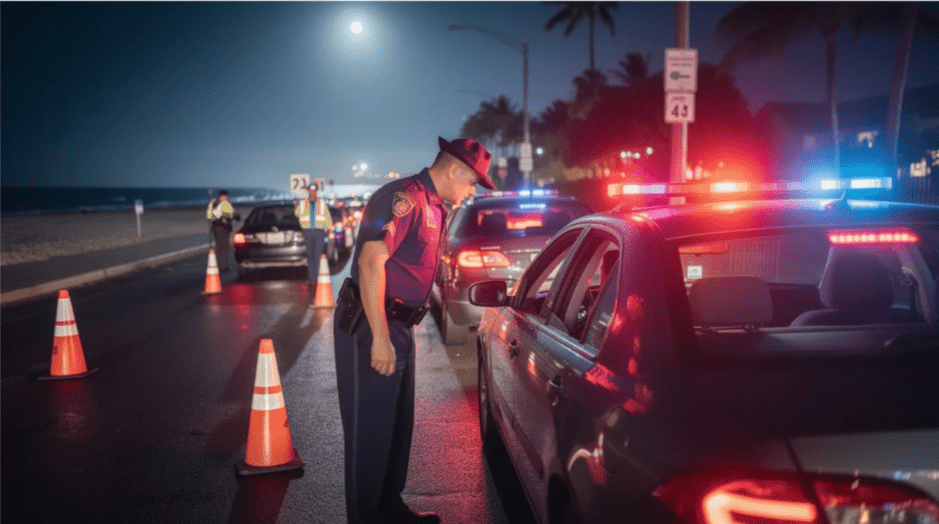
Texas DWI laws are strictly enforced in Galveston County, which includes the port city of Galveston on Galveston Island. The county’s law enforcement agencies regularly conduct DWI checkpoints and enhanced patrols, especially during high-risk holiday periods such as Labor Day, July 4th, and New Year’s Eve. These checkpoints are designed to improve visibility of impaired driving enforcement and deter offenders. The community’s coastal geography and port operations reflect a city that was once the largest in Texas and known as the Wall Street of the Southwest for its trade and commerce. The 1900 storm, the deadliest natural disaster in U.S. history, led the city to strengthen coastal protection by building a 17-foot seawall.
Penalties for a first DWI offense in Galveston County can include fines up to $2,000, jail time up to 180 days, and license suspension for up to one year. Repeat offenses carry significantly harsher penalties, including longer jail terms and extended license suspensions. Additionally, Texas law requires many DWI offenders to complete alcohol education or DWI classes, which may be mandatory for reinstating driving privileges.
Galveston County courts handle both the criminal charges and the Administrative License Revocation (ALR) proceedings separately. Drivers must be aware of ALR deadlines, such as requesting a hearing within 15 days after receiving a suspension notice, to protect their driving rights. Failure to request an ALR hearing can lead to automatic license suspension, regardless of the outcome of the criminal case. The Seawall is a 10-mile-long structure that provides beach access and promenades. The island’s rich architectural heritage continues to attract visitors today.
History and Legal Controversies of DWI Checkpoints in Galveston
DWI checkpoints have been a common enforcement tool used by Galveston County law enforcement for decades, particularly in response to the severe consequences of causing a DWI accident in Texas. These checkpoints are intended to catch impaired drivers and enhance public safety on the roads around Galveston Bay and the Gulf Coast. Before European settlement, the island was used for fishing and hunting by Indigenous tribes, and it was later named after Spanish military leader Bernardo de Gálvez. However, their use has not been without controversy.
The legal history of DWI checkpoints in Galveston reflects broader constitutional debates about the balance between public safety and individual rights. Challenges have been raised in local courts regarding the legality of checkpoints, focusing on Fourth Amendment protections against unreasonable searches and seizures. To be lawful, checkpoints in Texas must follow strict guidelines, including advance public notice, supervisory oversight, minimal intrusion, and adherence to established procedures.
Despite these safeguards, some Galveston cases have seen evidence suppressed due to procedural errors or violations of constitutional rights during checkpoint stops, especially when officers mishandle DWI blood test refusals and search warrants. These “checkered” legal issues highlight the importance of proper checkpoint planning and execution by law enforcement, as well as the critical role of experienced legal defense in protecting drivers’ rights.
In the early 19th century, Jean Lafitte used Galveston as a base for privateering.
Galveston remains a vibrant port city with a unique culture and history, from its strategic location on the Gulf to its role as a historic immigration gateway. Galveston’s Golden Age in the mid-to-late 19th century brought immense prosperity, and that era’s economic growth helped influence the city’s development while its role as an immigration port fostered a diverse population. It is also a historic island city known as the birthplace of Juneteenth, which originated there on June 19, 1865. The Strand Historic District features one of the nation’s largest collections of Victorian architecture. The local enforcement of DWI laws reflects the community’s commitment to safety while navigating the challenges posed by its coastal geography, tourism, and active port operations.
Sources, Check Point Research, and research date
- TxDOT: Summer Ends. Sober Rides Stay Forever, August 13, 2026
- NHTSA: Drive Sober or Get Pulled Over, August 18, 2026
- KPRC 2: Houston-Area 2025 Labor Day No Refusal Initiative
- Texas DPS: Administrative License Revocation Program
- Texas Penal Code Chapter 49
- Texas Transportation Code Chapter 724
- Texas Court of Criminal Appeals: Beeman v. State
Readers looking into Galveston legal matters may also need basic local government and court context, as well as an understanding of The Law Offices of Tad Nelson & Associates and its role in the community. As of 2020, Galveston had a population of 53,695, with 33.2% married-couple households, 25.3% male householder households without a spouse, and 34.9% female householder households without a spouse. Galveston is served by the Galveston Independent School District; the Galveston County Sheriff’s Office operates law enforcement headquarters, the Galveston County Justice Center houses judicial functions, and the city is home to the United States District Court for the Southern District of Texas.
*This page provides general information about Texas law. It is not legal advice and does not create an attorney-client relationship.
The post 2026 Labor Day DWI Crackdown and “No Refusal”: What Houston and Galveston Drivers Should Know appeared first on The Law Offices of Tad Nelson & Associates.
from The Law Offices of Tad Nelson & Associates https://ift.tt/axwLVck
via IFTTT


Comments
Post a Comment